Decision meeting · Manufacturing authorization
Approve D14 Rolltop manufacturing.
The only design that packs flat into a dive bag —
soft TPU-aramid body, rigid force-sensed window, three rolls and clamp. Always with you. Usable through glass.
Today’s ask
Authorize Phase P0→P1: CNC/ soft-tool bezels, RF-weld fabric bodies, window + load-cell stack, and dunk-proof campaign — prove the soft-goods seal before production tooling.
6 mDesign depth
122 gMass target
~40%Packed vs rigid volume
P1What we need approved
Why this meeting matters
Availability beats another hard case.
- People forget dry bags. A rigid case only works if it came on the trip.
- D14 lives in the kit: packs to ~40% of any rigid Nereid shell — disappears until water shows up.
- Survey-aligned: waterproof + phone usable through the window — not a dead pouch.
- Without a soft-goods manufacturing path, we only know how to machine boxes. The packable SKU — and the campus dunk demo story — dies on paper.
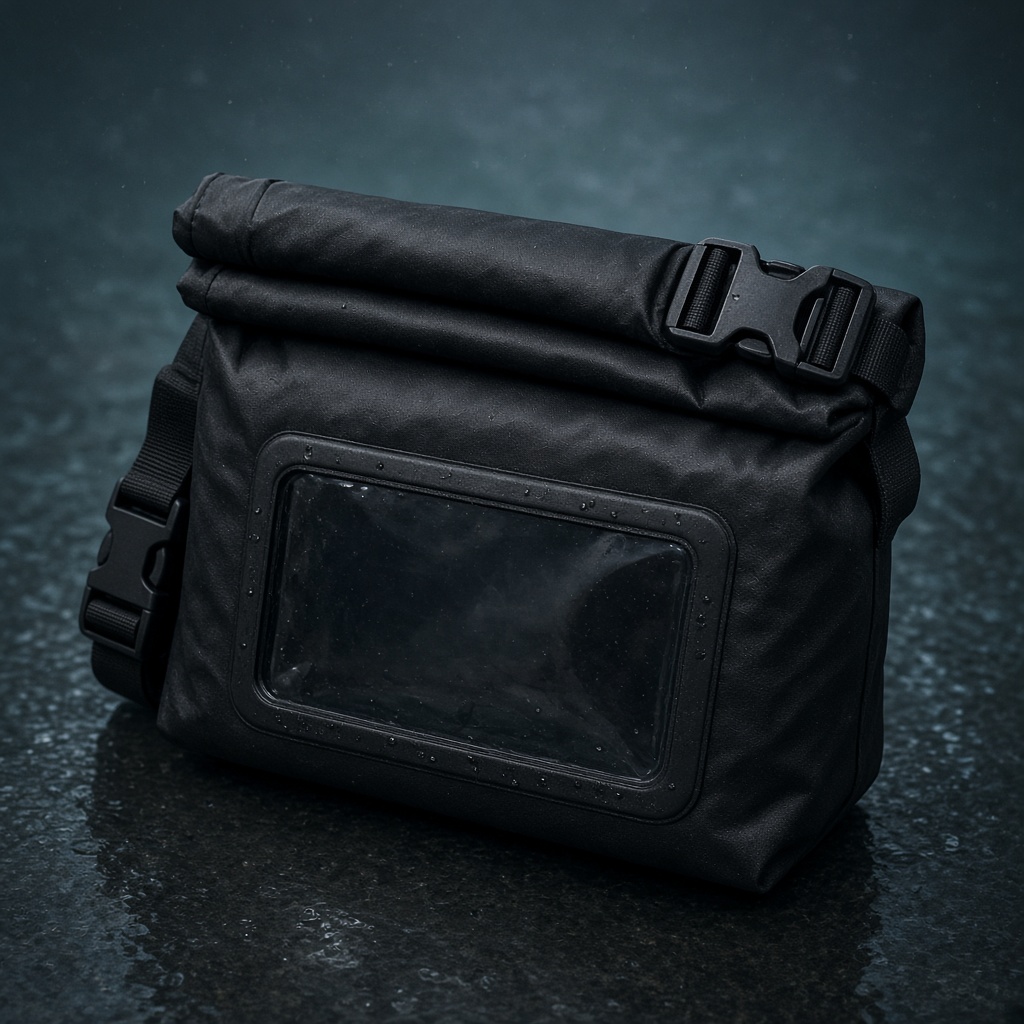
Product concept · Rolltop · fabric body · rigid sensing bezel
The engineering bet
Hard where it senses. Soft everywhere else.
500D aramid + TPU · RF-welded to bezel lip · 3 rolls + buckle · A1 load-cell glass
Rigid-only path
- Always the same bulk in the bag
- Impact goes into the shell
- Seal = O-rings on mating halves
- Great for abuse; poor for “bring it every time”
D14 path
- Fabric body absorbs hit by deforming
- Only hard part = force-sensed window bezel
- Closure = trained roll + dual side-release clamp
- Manufacturing owns RF weld + fold discipline + bezel FAIR
Touch through glass · 4 load cells
Roll seal · 3 folds minimum
Risk · bezel edge impact
What we would build
D14 Rolltop — locked spec
| Parameter | Spec |
|---|
| Envelope (deployed) | 175 × 95 × 40 mm |
| Aperture | 148 × 70 mm glass |
| Body | 500D aramid + TPU coat |
| Bezel | PPA / Mg · flange for RF weld |
| Sensing | A1-style 4 load cells · 61 g stack |
| Closure | 3 rolls + 2 side-release buckles |
| Mass budget | 122 g (34+61+16+11) |
| Depth | 6 m design · dunk-proof 1.5× |
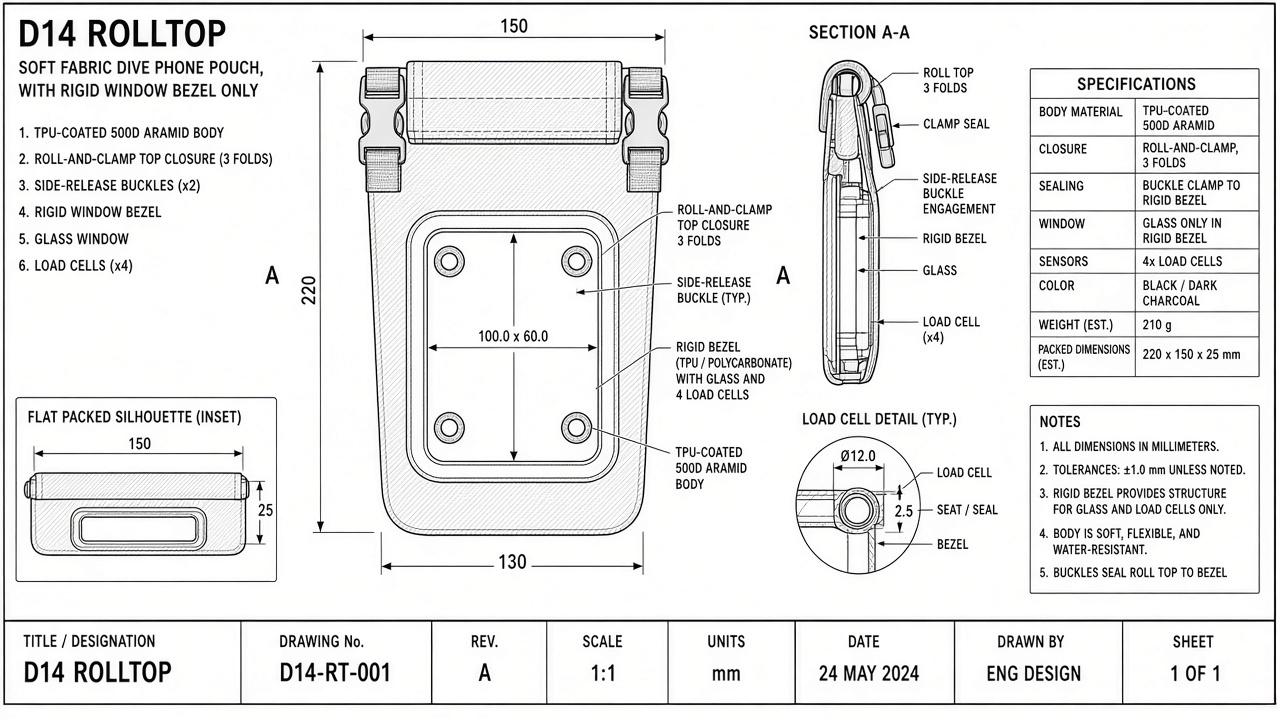
Blueprint · CAD STEP/STL · models/D14/
We are not starting from a napkin
The package already exists.
Geometry
rigid_bezel.step · window · fabric cut pattern
Bezel volume 82.1 cm³ · flange for RF weld lip
BOM & mass
Body 34 + bezel/window/cells 61 + battery/BLE 16 + buckles 11
= 122 g
Training media
HQ explode / work · lifestyle pack shot · film
D14-rolltop.mp4
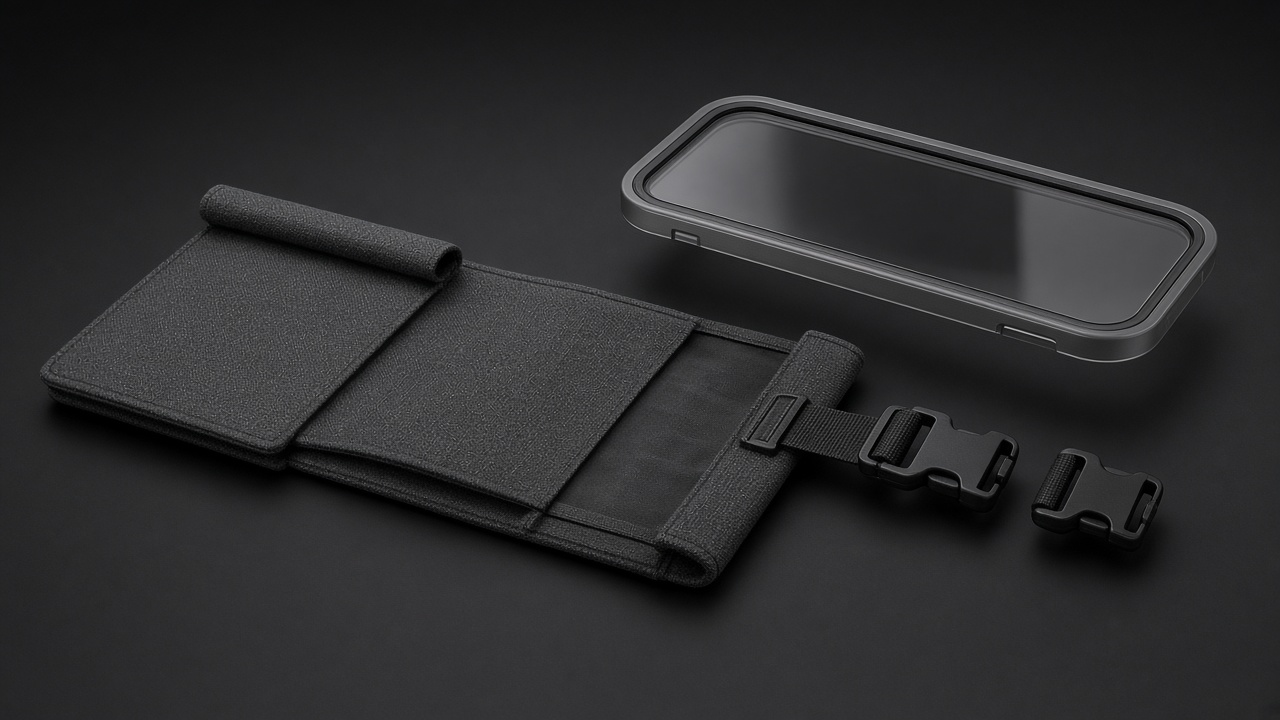
Exploded manufacturing still
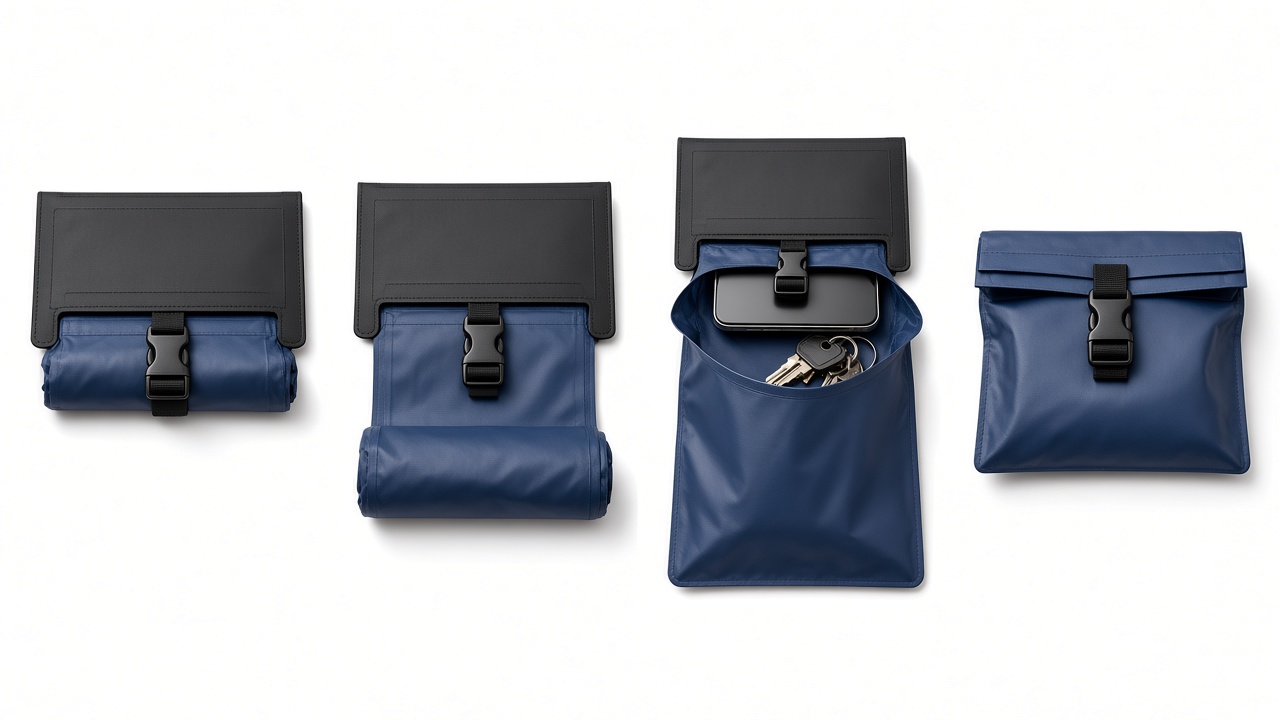
Roll / clamp use sequence (soft-goods cousin)
Freeze-before-tooling
The weld and the fold are the product.
RF weld stack
TPU face → bezel seal lip (continuous)
No stitch penetrations below waterline
Peel strength target logged per lot
Fail mode if skipped: slow leak at flange that dunk demos expose publicly.
Roll discipline
3 folds minimum toward bezel
Dual side-release buckles clamp roll
Train + stencil fold marks on P1 samples
Proof: dunk every unit 1.5× design (≥9 m equiv / timed tank) after trained fold — not “shake and hope.”
Hard bezel edge is the known impact weak point — P1 includes edge bumper / bag-pad options before we call structure done.
De-risked authorization path
We are not asking for production fabric dies today.
P0
Pattern fit
Print bezel + paper/fabric mock. Phone cavity. No dunk.
P1
Weld + dunk
ASK TODAY. CNC bezel, RF-weld bodies, window stack, dunk proof.
P2
Live demos
Load cells live · campus dunk booth · touch-through-glass proof.
P3
Tooling
Bezel mold + production RF fixtures if P1/P2 pass.
P4
Production
SPC on peel strength, fold audit, dunk yield.
Why this structure wins the room
Capital follows a leak-free dunk — not a pretty render. Approve the process that can fail on the bench, not on stage.
Manufacturing system
Nine phases. Owned. Exit-gated.
| # | Phase | Exit criteria |
|---|
| 0 | Engineering freeze | STEP bezel + DXF pattern + fold spec signed |
| 1 | Materials RFQ | 2 sources: TPU-aramid, buckles, glass, cells |
| 2 | Bezel manufacture | FAIR flange flatness ≤ 0.05 mm; cell pockets |
| 3 | Fabric cut + RF weld | Peel test pass; no pinholes at lip |
| 4 | Window + load cells | Dry force calibration; no glass bind |
| 5 | Electronics | BLE + battery sealed in dry pocket |
| 6 | Fold training | Operator can hit 3-fold + clamp in <15 s |
| 7 | Dunk proof | 1.5× design, timed; no fog / no weep |
| 8 | Release | Serial + fold card + care kit |
What approval funds
P1 budget — prove the seal, not inventory.
| Line | Band |
|---|
| CNC / soft-tool bezels (8–12) | $1.5k–$4k |
| Fabric, RF weld shop time, fixtures | $1.5k–$4k |
| Glass + load cells + seals | $1.2k–$3k |
| Buckles / roll bars / labels | $0.3k–$0.8k |
| Dunk tank access + instrumentation | $0.4k–$1.5k |
| Electronics bring-up (BLE) | $1.5k–$4k |
| Labor / contingency (20%) | $1k–$2.5k |
| P1 authorization total | $7k–$18k |
~$11k
Planning midpoint to a pass/fail dunk answer in ~5 weeks from freeze.
Not funded by this vote
- Production bezel injection mold
- 100–250 unit inventory buy
- Full outdoor-gear certification filing
Five-week P1 clock
From freeze to dunk.
| Week | Focus | Visible output |
|---|
| 0–1 | Freeze STEP/DXF/fold spec; RFQ fabric & weld shop | Signed packet |
| 2 | CNC bezels + first RF-weld bodies | FAIR + peel coupons |
| 3 | Window/cells install; fold training | Dry UI + fold time log |
| 4 | Dunk campaign 1.5× | Pass/fail data pack |
| 5 | Go / no-go for P2 live demos | Decision memo |
Kill · flange leak or fold cannot seal
Success · ≥5 units dunk-pass with peel log
Preempt the objections
We already named what can kill us.
| Risk | If true | Mitigation in P1 |
|---|
| RF weld pinholes at lip | Public dunk fail | Peel coupons every lot; dye-pen flange |
| User under-rolls (1–2 folds) | “It leaked” reviews | Stenciled fold marks + <15 s training card |
| Bezel edge impact crack | Window breach | Edge bumper options; drop sample matrix |
| Touch through glass weak wet | No differentiator | Load-cell cal in dunk; reject if unusable gloved |
| Fabric abrasion / sand | Early wear | 510.7 sand exposure sample; coat check |
| COGS too high for $19.99 | Margin death | P1 actuals → price or scope decision before P3 |
Integrity
We will not oversell IPX claims.
After P1 pass we claim
- Bench dunk survival at 1.5× design
- Documented RF-weld + fold process
- Repeatable peel / fold / dunk logs
- “Soft-goods architecture validated for demos”
We will not claim yet
- IPX8 / dive-computer certification
- Life-critical or overhead diving use
- Unlimited depth or “military waterproof”
- Production yield or lifetime abrasion rating
Campus dunk demos only happen on serials that passed P1 proof. No exceptions for “it looked fine.”
Motion for the room
Approve P1 manufacturing authorization.
Approve
- Budget: up to $18k (target ~$11k)
- Scope: bezels, RF-weld bodies, window/cells, dunk proofs
- Duration: 5 weeks to go/no-go memo
- Success: ≥5 units dunk-pass with peel + fold logs
- Next gate: separate vote for P2 demos / P3 tooling
If you hold
We stay in rigid-case thinking. The packable, always-with-you SKU — and the dunk-demo sales motion — does not get built.
Holding is rational only if the group rejects soft-goods as a product thesis — not because this plan is incomplete.
D14 Rolltop
Pack flat. Roll shut. Prove the weld.
Full manufacturing plan, BOM, work instructions, and test gates are ready for the packet.
Deck · d14-approval.html
Plan · manufacturing/D14-…Plan.md
Leave-behind · d14-approval-brief.html
Notes · D14-SPEAKER-NOTES.md
Decision
Do we authorize P1 — yes or no?