Decision meeting · Manufacturing authorization
Approve D15 Oilfill-100 manufacturing.
The only design in the Nereid catalog that reaches true 100 m depth
without thickening the walls into a brick — by making pressure disappear.
Today’s ask
Authorize Phase P0→P1: CNC bridge housings, oil-fill station, and hydrostatic proof campaign — so we can prove the physics before committing mold steel.
100 mDesign depth
15 barProof gate (1.5×)
178 gMass target
P1What we need approved
Why this meeting matters
Depth is the credibility product.
- Every recreational case tops out ~6–20 m by fighting pressure with thicker walls and heavier glass.
- D15 is the category jump: oil compensation → ΔP ≈ 0 → 1 mm walls at 100 m.
- Without a manufacturing path, D15 is a slide in a catalog. With it, we have a moat.
- If we do not de-risk P1 now, we cannot honestly claim a depth product — and the program stalls at snorkel-class hardware.
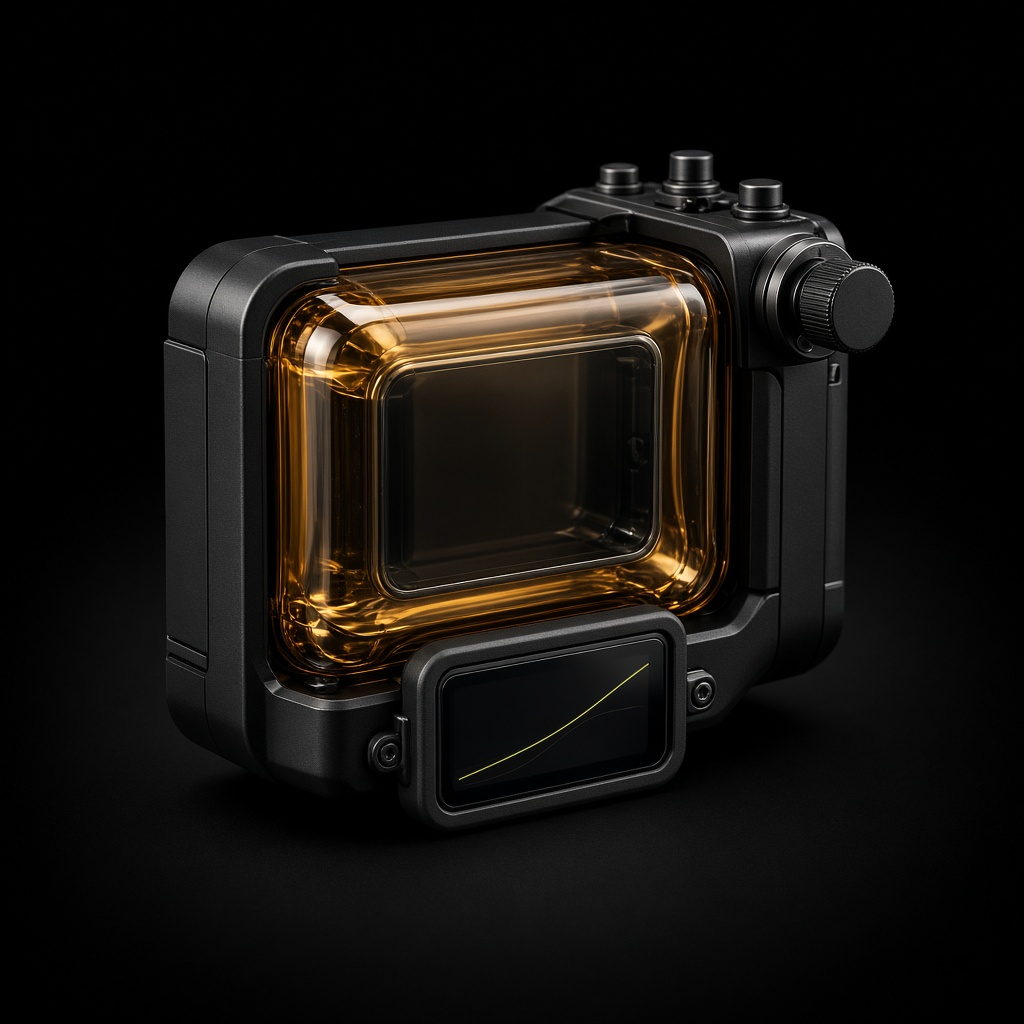
Product concept · Oilfill-100 · sealed OLED readout · physical keys
The engineering bet
Don’t fight pressure. Equalize it.
Ambient water pressure → rolling diaphragm → silicone oil → ΔP across shell ≈ 0
Old way (A4 Titan path)
- Thicker metal + thicker optic
- Mass climbs fast past 20 m
- Cost and tooling explode
- Still a dry-air pressure vessel
D15 way (oilfill)
- 1 mm PPA shell — not a pressure vessel
- Oil transmits ambient pressure
- Diaphragm takes the stroke
- Depth rating becomes a seal + diaphragm + fill process problem — which manufacturing can own
Phone immersed · screen sacrificed
UI = sealed OLED + keys
Honest trade · depth over touchscreen
What we would build
D15 Oilfill-100 — locked spec
| Parameter | Spec |
|---|
| Envelope | 170 × 90 × 35 mm |
| Wall | 1.0 mm PPA (compensated) |
| OLED aperture | 50 × 30 mm dry bay |
| Diaphragm port | Ø24 mm rolling VMQ |
| Oil fill | ~350–400 mL dielectric silicone |
| Reservoir | ≥40 mL (−32…+71 °C) |
| Mass budget | 178 g (line-item owned) |
| Controls | C10-style encoder + hat keys |
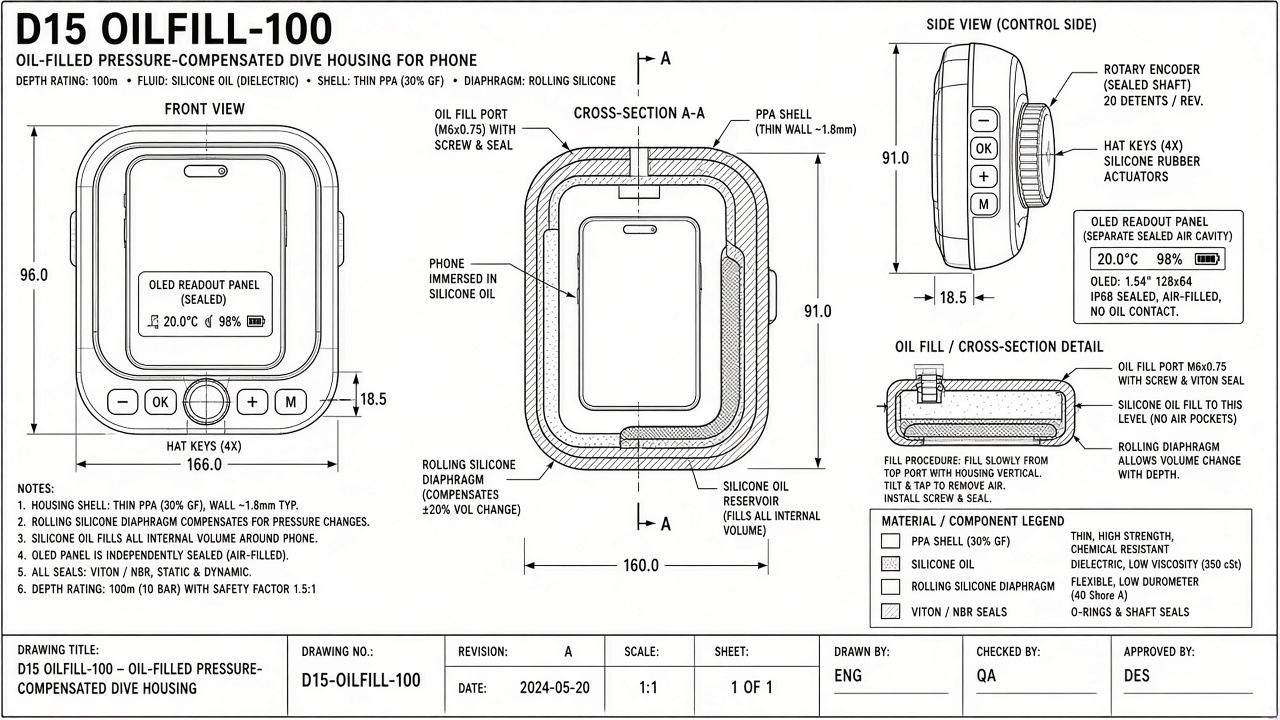
Blueprint · CAD STEP/STL already exported · models/D15/
We are not starting from a napkin
The package already exists.
Geometry
oil_shell.step + oil_lid.step
45.7 cm³ shell · 15.3 cm³ lid · parametric rebuild via build_all.py
BOM & mass
14-line production BOM with process + mass owners
28+52+34+16+16+32 g = 178 g
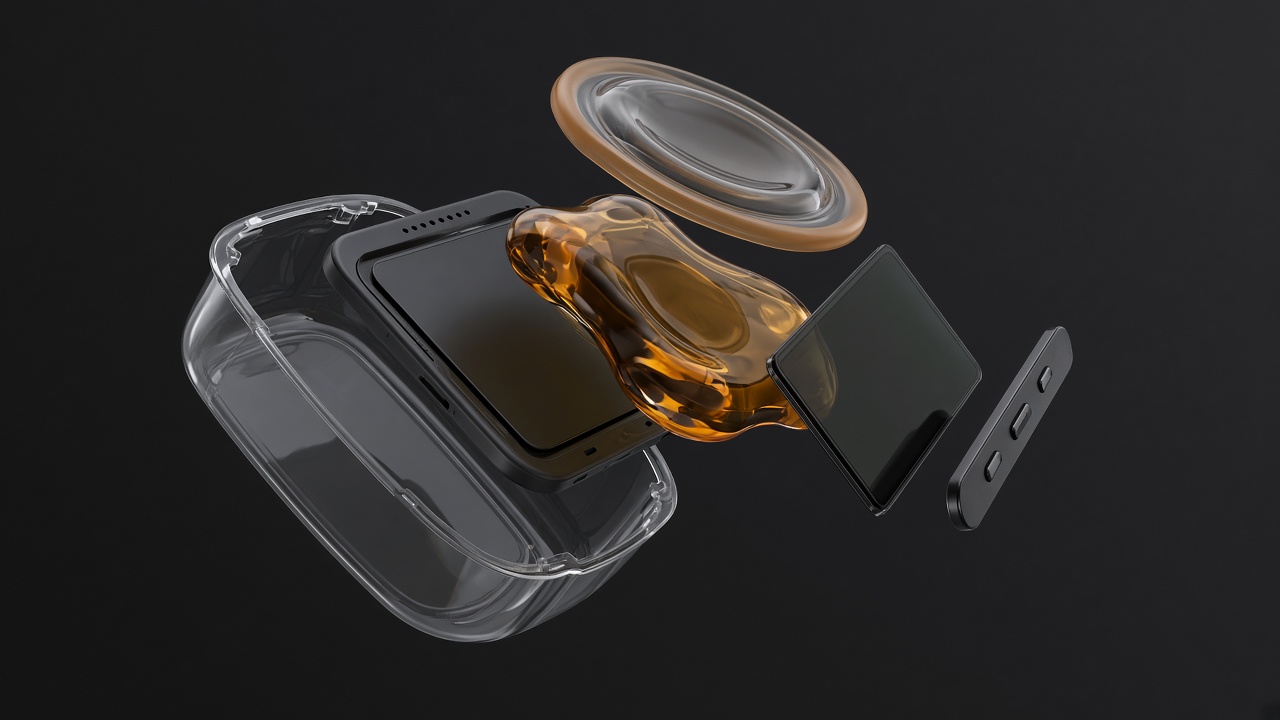
Exploded manufacturing still

Working depth scenario
Freeze-before-tooling math
The reservoir is non-negotiable.
If we under-size expansion volume, the case bulges or spits seals in heat. This is the number that kills programs that “just fill it with oil.”
Thermal expansion
V_oil ≈ 400 mL
CTE ≈ 0.00095 / °C (silicone oil)
ΔT = 71 − (−32) = 103 °C
ΔV ≈ 400 × 0.00095 × 103 ≈ 39 mL
Spec floor: ≥40 mL free + 25% margin → ~50 mL design
Pressure proof
Design: 100 m → 10 bar
Proof (every unit): 15 bar × 15 min
Working hold: 10 bar × 30 min + UI exercise
Pass = no weep, no diaphragm tear, no OLED fog, keys still actuate.
FDM shells are explicitly excluded from this gate.
De-risked authorization path
We are not asking for mold steel today.
P0
FDM fit
Dry phone cradle, screw map. No water. Cheap.
P1
CNC + oil
ASK TODAY. PEI/PPA housings, fill station, 15 bar proof.
P2
Pool pilots
Full electronics. Supervised ≤5 m. UX truth.
P3
Tooling samples
Only if P1/P2 pass. Mold steel then.
P4
Production
SPC on oil mass + proof yield. Cert path.
Why this structure wins the room
Capital follows evidence. Approve the experiment that can fail cheaply — not the mold that fails expensively.
Manufacturing system
Nine phases. Owned. Exit-gated.
| # | Phase | Exit criteria |
|---|
| 0 | Engineering freeze | STEP + oil calc + seal stack signed |
| 1 | Materials RFQ | 2 qualified sources oil / diaphragm / polymer |
| 2 | Housing | FAIR glands ±0.05 mm; Ra ≤ 0.8 µm |
| 3 | Diaphragm / reservoir / valve | Stroke covers ≥50 mL; leak-free dry |
| 4 | Electronics dry bay | OLED bay vacuum-tight; BLE link |
| 5 | Dry assembly | 1 bar soap / decay pass before oil |
| 6 | Oil fill & bleed | Mid-stroke diaphragm; mass ±5 g; no bubbles |
| 7 | Hydro proof | 15 bar / 15 min then 10 bar functional |
| 8 | Release | Serial + fill log + maintenance kit |
What approval funds
P1 budget — evidence, not inventory.
| Line | Band |
|---|
| CNC bridge housings (5–10 sets) | $2.5k–$6k |
| Diaphragms, valves, seals, oil | $1k–$2.5k |
| Fill/bleed station setup | $1k–$3k |
| Hydro pot access (rent or buy) | $0.8k–$8k |
| Electronics bring-up (OLED/MCU) | $3k–$8k |
| Labor / contingency (20%) | $1.5k–$4k |
| P1 authorization total | $10k–$28k |
~$18k
Planning midpoint to reach a pass/fail hydrostatic answer in ~6 weeks from freeze.
What we are explicitly not funding yet
- Steel production molds ($8k–$25k NRE)
- 100-unit inventory buy
- Full dive certification filing
Six-week P1 clock
From freeze to proof.
| Week | Focus | Visible output |
|---|
| 0–1 | Freeze STEP, oil mass, seal stack; RFQ | Signed engineering packet |
| 2–3 | CNC housings + diaphragm/valve intake | FAIR report |
| 4 | Fill station + first dry leak + first fills | Process sheet v1 |
| 5 | Hydro campaign 15 bar | Pass/fail data pack |
| 6 | Go / no-go for P2 electronics + pool | Decision memo |
Kill criterion · cannot hold 15 bar dry-or-oil
Success · ≥3 units pass proof with logged oil mass
Preempt the objections
We already named what can kill us.
| Risk | If true | Mitigation in P1 |
|---|
| Oil attacks phone seals | Bricked phones | 30-day sacrificial soak + CoC oil only |
| Diaphragm fatigue / tear | Flood at depth | Stroke cycle bench + inspect after every proof |
| Users reject no phone screen | No demand | OLED UX demo before P3 tooling |
| Reservoir undersized | Seal spit in heat | Measure oil mass → re-freeze ≥50 mL |
| Knit lines on O-ring lands | Chronic leakers | CNC bridge first; mold-flow before steel |
| BLE dies in filled PPA | No UI link | RF window keep-out in dry bay |
Integrity
We will not oversell certification.
What we will claim after P1 pass
- Bench hydrostatic survival at 15 bar
- Documented fill/bleed process
- Repeatable oil-mass control
- “Prototype depth architecture validated”
What we will not claim yet
- CE / PE / dive-equipment certification
- Life-support or buddy-critical use
- Consumer 100 m rating on a sell sheet
- FDM parts as dive hardware
That honesty is how you keep the room’s trust when the pressure pot is still ahead of us.
Motion for the room
Approve P1 manufacturing authorization.
Approve
- Budget: up to $28k (target ~$18k)
- Scope: CNC housings, fill station, hydro proofs, oil/diaphragm quals
- Duration: 6 weeks to go/no-go memo
- Success: ≥3 units pass 15 bar with logged process
- Next gate: separate vote for P2/P3
If you hold
We remain a catalog of recreational-depth ideas.
D15 stays a render. The depth moat does not get built.
Holding is rational only if the group rejects depth as a product thesis — not because the plan is incomplete.
D15 Oilfill-100
Make pressure disappear — then prove it.
Full manufacturing plan, BOM, work instructions, and test gates are ready for the packet.
Deck · this presentation
Plan · manufacturing/D15-…Plan.md
Leave-behind · d15-approval-brief.html
Notes · SPEAKER_NOTES.md
Decision
Do we authorize P1 — yes or no?